
How to Choose a Commercial Countertop for Your Business?
Choosing a Commercial Countertop is more than a design decision. It affects daily cleaning, workflow, repair costs, and how well a workspace holds up under pressure. A café serving espresso may need a surface that handles hot equipment and frequent spills. A bakery might care more about a smooth prep area and enough room for trays. The right choice depends on the work happening on the counter.
Looks matter. Yet a glossy finish can show fingerprints, while a textured surface may take longer to clean. Granite, quartz, stainless steel, and laminate each bring different strengths and limitations. Heat resistance, moisture exposure, impact, seam placement, and edge details deserve attention. So does the structure beneath the counter; even a durable surface can fail if its support is poorly planned.
Start by listing your busiest tasks and the products or tools that touch the counter each day. Then compare material specifications, care instructions, warranty terms, and installation requirements. Ask suppliers how a surface responds to your actual cleaning products, not just general household cleaners. A physical sample can help you judge color and texture, but it cannot reveal every long-term issue. No surface is perfect. Owners sometimes choose by appearance first and reconsider after seeing daily wear. That trade-off is worth discussing with an experienced fabricator before ordering. A well-chosen Commercial Countertop should fit your operations, maintenance routine, and budget—not just the showroom.
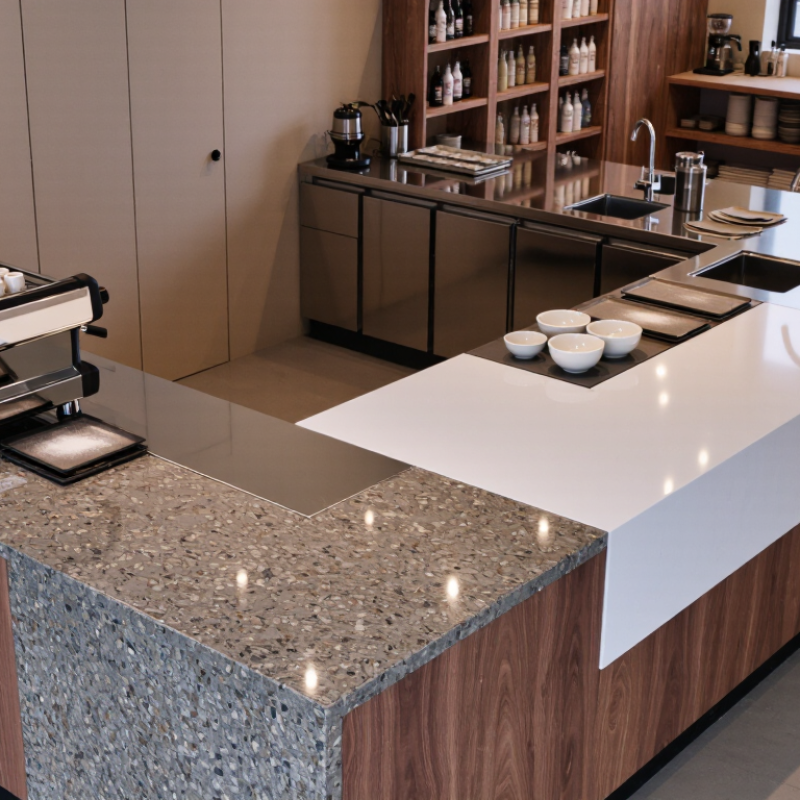
Table of Contents
[Hide]
Identify Your Business’s Operational and Space Requirements
Map the work before comparing countertop materials. List each task performed at the counter: chopping, plating, packing orders, handling payments, or storing small tools. Watch the busiest hour, not a quiet morning. Do staff reach across one another, or leave wet containers beside the register? These small patterns reveal where the surface needs to be durable, easy to clean, or simply kept clear. That overlap matters.
Measure the room, including doorways, aisles, and the space around fixed equipment. A counter that fits on paper may block a refrigerator door or narrow the route between prep and service. Leave room. Note the footprint of sinks, warmers, scales, and point-of-sale equipment, then mark their positions on a simple floor sketch. Also check counter height and depth against the people who will use it. A few inches can change whether a worker can reach tools comfortably during a long shift.
Think about cleaning routines and future changes, too. Will the counter face frequent spills, sharp tools, hot cookware, or heavy appliances? Record those conditions rather than guessing from appearance. It is easy to overestimate how much work surface a team needs; it is also easy to miss storage and turning space. Recheck measurements after moving equipment, because plans often drift from the real room. A little awkward, perhaps, but an honest site check beats a costly fit problem.
How to Choose a Commercial Countertop for Your Business? - Identify Your Business’s Operational and Space Requirements
| Planning dimension | Questions to assess | Practical planning reference | How it affects countertop selection |
|---|---|---|---|
| Primary work | Will the surface be used mainly for food preparation, plating, service, checkout, or equipment support? | List each task and the equipment, tools, or materials it requires. | Choose a material and layout suited to the work: for example, a smooth, cleanable surface for food prep or a heat-resistant surface near hot equipment. |
| Peak workload | How many staff members work at the counter during the busiest period? How many orders or transactions are handled at once? | Observe a busy shift and record simultaneous tasks, queues, and points where staff need to pass one another. | A longer counter or separate task zones can reduce crowding. Avoid adding length if it blocks circulation or creates unused work area. |
| Available floor space | What are the room dimensions, doorway widths, fixed obstructions, and required paths through the space? | Measure the proposed footprint and the clear routes around it. A 36-inch clear route is a common accessibility reference in the U.S.; applicable requirements depend on the site and local code. | Consider a shorter run, corner configuration, or shallower depth if needed, while preserving required accessible routes and safe movement. |
| Counter height | Will staff perform detailed seated work, standing prep, or customer-facing service? | Many standing work counters are planned around 34–36 inches high. In the U.S., accessible counter requirements vary by use and configuration; accessible portions are commonly within 28–34 inches. | Set height for the task and users, and include an appropriately designed accessible section where required. Confirm measurements against applicable codes. |
| Counter depth and reach | How much room is needed for work, equipment, storage, or customer interaction? | Common worktop depths include approximately 24, 30, and 36 inches; the right depth depends on the equipment and layout. | Select enough depth for the intended task without reducing aisle clearance. Check that staff can comfortably reach the entire working area. |
| Equipment and cutouts | Will the counter include a sink, faucet, cooktop, dispenser, POS terminal, or other fixed equipment? | Record each unit’s manufacturer-specified dimensions, service access, utility connections, and required clearances before fabrication. | Plan cutouts and seams around equipment and support points. Keep access panels and maintenance areas reachable after installation. |
| Heat, moisture, and chemicals | Will the surface contact hot cookware, standing water, oils, acids, cleaning agents, or frequent spills? | Review the material’s published limits for heat, water exposure, staining, and approved cleaning products. | Match the surface to actual exposure. Use trivets or other protection where required, and avoid assuming any material is damage-proof. |
| Cleaning and hygiene | How often will the counter be cleaned, and are food-contact or sanitation requirements applicable? | Check local health rules and the surface manufacturer’s cleaning and maintenance instructions. | Favor a cleanable, well-maintained surface and detail joints, edges, and backsplash areas to limit hard-to-clean gaps. |
| Load and support | Will the counter support heavy equipment, stored goods, or concentrated loads near an edge or cutout? | Include the countertop, equipment, and stored items when estimating load; have the base and support design checked for the intended use. | Coordinate material thickness, support spacing, overhangs, and reinforcement with a qualified fabricator or installer. |
| Utilities and installation access | Where are plumbing, electrical, and ventilation connections? Can the countertop be moved through the building? | Verify connection locations, shutoffs, route dimensions, lift access, and installation sequence before ordering. | Choose practical sections and seam locations, and coordinate cutouts with trades before fabrication begins. |
| Maintenance and downtime | Can the business accommodate periodic sealing, repairs, or replacement without disrupting service? | Compare care instructions, repair options, expected maintenance, and the availability of replacement sections. | Choose a maintenance plan that fits staffing and operating hours, not just the initial purchase cost. |
| Final site verification | Have measurements, access needs, equipment specifications, and local code requirements been confirmed? | Use a site measurement and written equipment schedule before approving drawings or fabrication. | Confirm the complete layout with the installer and relevant building, accessibility, fire, and health authorities as applicable. |
Planning note: Dimensions and accessibility references are general guidance, not a substitute for site measurements or applicable local codes.
Related Posts
-
The Definitive Handbook to Custom Counter Tops: Elevate Your Space with Style and Functionality
-

Mastering Commercial Countertop Selection: A Step-by-Step Guide to Boost Efficiency by 30%
-

7 Reasons Why the Best Commercial Countertop Is Essential for Your Food Business Success
-

Ultimate Guide to Choosing the Perfect Stone Countertop for Your Home
-

How to Choose Quartz Stone Countertops for Your Home?
-
What is the Best Solid Surface Material for Your Project?