Why Choose a Polyester Carport for Your Business?
A business carport is more than a roof over parked vehicles. It can shelter delivery vans, work equipment, or a temporary loading area from sun and rain. A Polyester Carport may appeal to businesses seeking a covered space without building a permanent structure. Polyester fabric is relatively lightweight, but its performance depends on the fabric weight, coating, seams, and frame design. Details matter. A product described as weather-resistant should still be checked against its actual specifications, not just its name.
For a practical comparison, consider the dimensions of your vehicles, daily access, drainage, and how the structure will be secured. Ask the supplier about UV protection, water resistance, frame materials, replacement parts, and care requirements. Also review wind and snow guidance for the specific model and installation site. These ratings are not interchangeable. A shelter that works well beside a small workshop may not suit an exposed lot or frequent vehicle traffic. That is easy to overlook. The right choice depends on your operating conditions, available space, and maintenance capacity—not on fabric alone. Polyester can offer a useful balance of coverage and flexibility, yet it is not maintenance-free, and no fabric shelter should be assumed to withstand every storm. Before buying, compare documented specifications with the needs of your site. A little doubt is useful here. It can prevent an attractive price or image from standing in for dependable performance.
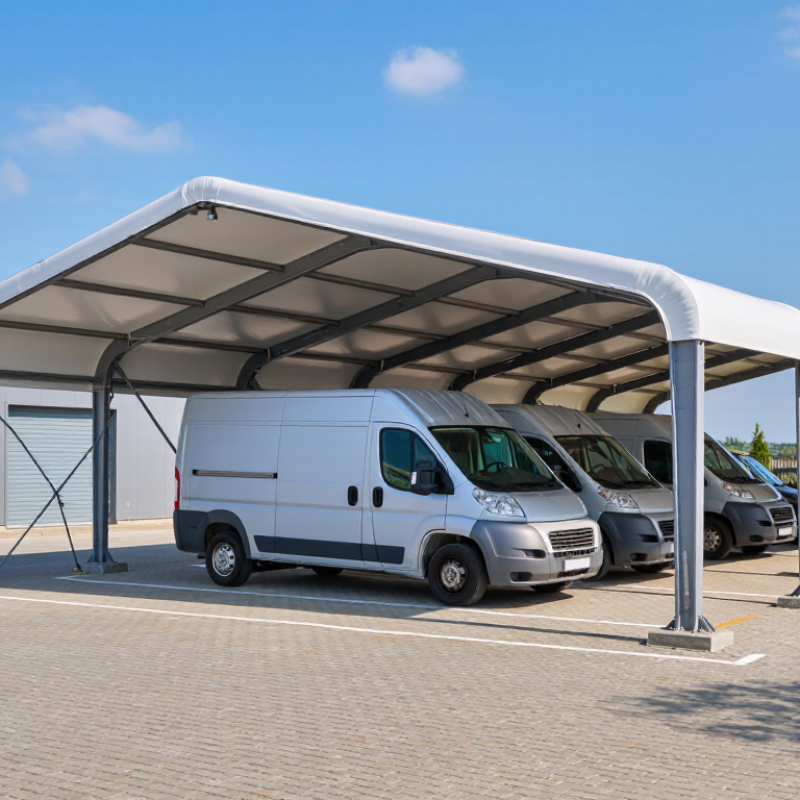
What a Polyester Carport Is and How It Is Constructed
A polyester carport is a tensioned fabric shelter, not a rigid roof. Its canopy usually uses woven polyester yarns, sometimes finished with a PVC or polyurethane coating for water resistance and easier cleaning. The exact fabric, coating, and frame vary by design. Details matter.
Construction begins with cutting fabric panels to fit the roof shape. Workers join the panels with sewn seams or heat-welded joints, then reinforce edges and stress points. Metal eyelets, straps, or pockets connect the canopy to a frame, commonly made from steel or aluminum. The legs and crossbars carry the load; suitable anchoring helps keep the structure stable in wind. A neat-looking canopy is not proof of correct installation.
Polyester is widely used in technical and consumer textiles. Textile Exchange’s Materials Market Report 2024 estimates that polyester made up 57% of global fiber production in 2023, or roughly 71 million tonnes. That figure shows the material’s scale, not a guarantee of carport lifespan. Check the fabric weight, coating, seam method, frame finish, and care instructions before choosing one for a business. Small print can be easy to miss. Polyester fabric can still wear, fade, or collect water if the design, setup, or maintenance falls short.
Why Choose a Polyester Carport? Material Densities
A polyester carport typically uses a coated polyester-fabric canopy supported by a metal frame. This chart compares representative densities of polyester fiber, aluminum, and carbon steel—not the weights of complete carports. Actual fabric coatings, frame alloys, and designs vary.
How Polyester Fabric Performs in Commercial Environments
Why Choose a Polyester Carport for Your Business?
How Polyester Fabric Performs in Commercial Environments
A polyester carport can provide practical shade and weather cover for vehicles, equipment, or customer parking. Its performance depends on more than the fabric alone. Coatings, seam quality, frame design, and correct tension all affect how well the shelter handles rain and sun. That matters. A tightly fitted, well-maintained cover is less likely to flap in ordinary wind, while loose fabric can wear faster at contact points.
In commercial settings, polyester is valued for its relatively light weight and straightforward installation. Depending on its coating and specifications, it may resist moisture and reduce UV exposure beneath the canopy. It is not a cure-all. Strong winds, standing water, sharp branches, and repeated abrasion can shorten its service life. Inspect the roof after storms, especially around seams and frame connections. One detail operators sometimes overlook is drainage: even durable fabric can sag when water pools. The right model should match local weather, expected use, and the size of the area being covered.
Tips: Check the product’s fabric and wind specifications before purchase. Keep the cover taut, clear debris promptly, and look for small tears before they spread. Record inspections; busy sites can miss early wear.
Business Benefits of Choosing a Polyester Carport
A polyester carport gives a business covered parking without the weight and permanence of a conventional roof. Staff can walk from the lot with less exposure to rain, while customers find cars easier to locate under a clearly marked canopy. The fabric also softens direct sun on parked vehicles, though it cannot prevent every temperature-related effect or storm impact. The trade-off is real. Fabric tension, drainage, and anchoring need regular checks, especially after strong winds.
For businesses considering future upgrades, a carport may provide a useful platform for solar panels, if its frame and foundations are engineered for added loads. The International Energy Agency’s Renewables 2024 report forecasts nearly 5,500 GW of global renewable capacity additions between 2024 and 2030, with solar PV accounting for almost 80% of the increase. That is a market signal, not proof that every canopy is solar-ready. Ask for load calculations, fire-performance documentation, and a maintenance schedule before purchase. Polyester’s lighter structure can simplify installation on some sites, but local wind and snow conditions still determine the design. A small detail matters: water pooling can shorten fabric life, so inspect the slope and drainage before signing off.
Factors to Consider When Selecting a Commercial Carport
Why Choose a Polyester Carport for Your Business?
Factors to Consider When Selecting a Commercial Carport
A commercial carport needs to suit daily work, not just look spacious in a photo. Measure the vehicles, equipment, and walking routes you expect to protect. Check roof height and side clearance, especially near delivery bays. Polyester fabric can provide a lightweight canopy, but coatings, seams, and frame construction affect durability. Compare product specifications for UV resistance, water shedding, and wind performance. Do not assume every fabric structure handles the same weather. A wet corner after rain can reveal a drainage problem you missed on paper.
Tips: Ask for written load ratings and installation requirements. Check whether anchors suit your actual ground, such as asphalt or compacted soil. Keep service access clear.
Think about how staff will use the space in winter and during busy shifts. A wide entrance may matter more than extra covered area. Ask a qualified installer to assess site exposure and anchoring before purchase. Also consider cleaning and repair access; fabric may need periodic inspection for loose fittings, tears, or pooling water. These details feel minor until a storm arrives. I would still compare the total maintenance effort, not only the initial price.
Installation, Maintenance, and Long-Term Use
A polyester carport can be installed with less disruption than a permanent building, but reliable performance starts below the canopy. Check soil stability, drainage, anchor capacity, and local wind and snow exposure before setting the frame. Keep fabric tension even; loose panels flap, abrade at contact points, and strain seams. Small details matter. NOAA’s Fifth National Climate Assessment (2023) reports that the heaviest precipitation events in the Northeast have intensified by 55% since 1958. That figure is regional, not a design value, but it underscores why runoff and site-specific loading deserve attention.
For routine care, inspect the frame, anchors, seams, and fabric after severe weather, then clear leaves and standing water. Wash dirt with mild soap and water; harsh cleaners can damage coatings. Look for chafing around poles and small tears before they spread. Polyester’s useful life varies with coating, UV exposure, tension, and maintenance, so avoid relying on a single lifespan estimate. Ask for UV-aging and seam-strength test results for the actual fabric. ASTM D4329 describes fluorescent-UV exposure testing for plastics, but the test method should suit the coated textile being considered. A maintenance log helps reveal recurring wear. It will not prevent every failure, and missed inspections remain a real weakness.