Who Are the Top Vegetable Cutter Manufacturers in China?
China has a broad network of manufacturers serving commercial kitchens, food processors, and equipment distributors. Yet a polished product photo reveals little about blade consistency, motor performance, or cleaning access. A Vegetable Cutter must handle real ingredients, from firm carrots to leafy cabbage, without producing uneven pieces or slowing a busy preparation line. Small details matter. Buyers should compare cutting capacity, available blade styles, food-contact materials, safety features, replacement-part access, and after-sales support. Specifications deserve scrutiny, too. Published output rates may depend on the ingredient, cut size, and operating conditions.
Quality-management pioneer W. Edwards Deming wrote, “Quality comes not from inspection, but from improvement of the production process.” His principle offers a useful lens for assessing cutter makers: reliable results depend on design, assembly, testing, and ongoing quality control. It is a manufacturing principle, not a vegetable-cutter-specific endorsement. This guide examines how to identify leading Chinese manufacturers by looking beyond price and catalog claims. It considers product range, customization, production capability, export experience, and the evidence buyers can request before ordering. Ask for clear specifications. Request demonstration footage with comparable ingredients. Check how the machine opens for cleaning and how quickly common wear parts can be replaced. No single supplier suits every operation. A compact kitchen and a high-volume processor have different needs. The comparisons ahead aim to help buyers make a grounded shortlist—and to recognize where more verification is still needed.
What Are Vegetable Cutters and How Are They Used?
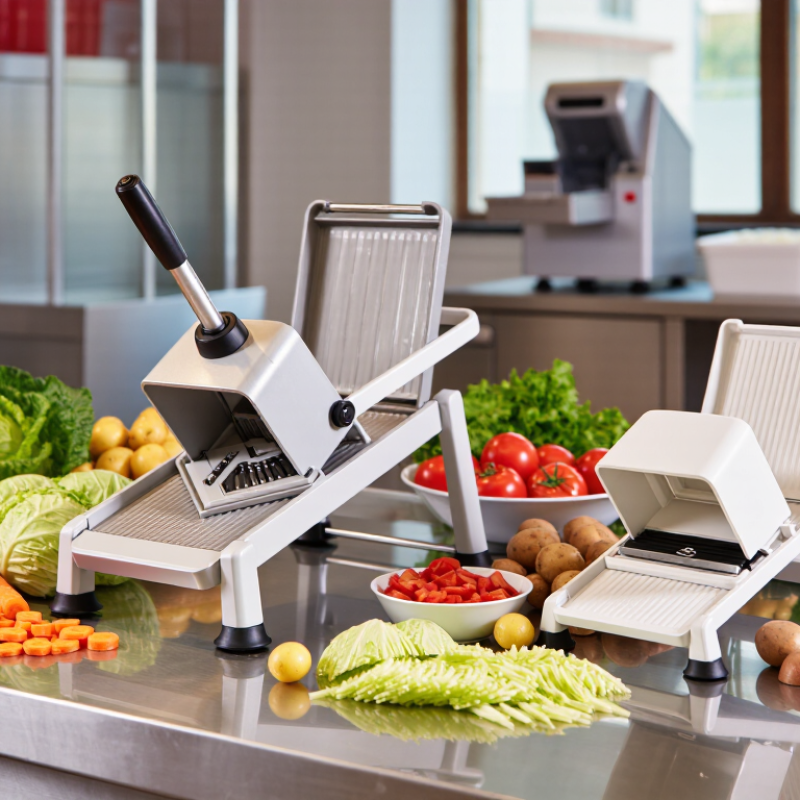
A vegetable cutter is a hand-operated or powered food-preparation tool that slices, dices, shreds, or wedges vegetables. Commercial models often use interchangeable blades, a feed chute, and a pusher to guide produce toward the cutting surface. In a busy kitchen, an operator might feed peeled carrots through a dicing grid, then switch blades to slice cucumbers. The aim is consistent portions and faster preparation, not culinary magic.
The United Nations Environment Programme’s Food Waste Index Report 2024 estimates that 1.05 billion tonnes of food were wasted worldwide in 2022 across households, food services, and retail. This figure covers all food, not vegetables alone. A cutter cannot prevent waste by itself, but controlled cuts can make usable portions more consistent. Uneven pieces may cook at different speeds. That matters.
Choose a cutter for the daily volume, the vegetables handled, and the desired cut size. Before use, check that the blade is secure and the guard is in place; keep hands away from the cutting edge. Clean and dry removable parts after use, since food residue can collect around blade mounts. The FAO’s 2019 report, The State of Food and Agriculture, estimated that 14% of food was lost between harvest and retail. That is a supply-chain-wide estimate, not a measure of kitchen cutting. Still, it reminds operators that careful handling matters at every stage. A cutter helps, but training and routine inspection matter too.
How Is China's Vegetable Cutter Industry Structured?
China’s vegetable cutter industry is made up of manufacturers with different roles and scales. Some operate compact workshops producing basic manual slicers, while larger factories assemble electric cutters for restaurant kitchens and food-processing facilities. Between them are suppliers of motors, blades, housings, and control parts. The chain is practical, but not always neatly separated: one factory may assemble machines while relying on outside suppliers for key components.
Manufacturers also differ in how much customization they offer. Some make standard models in volume; others adjust blade types, feed openings, or cutting capacity for specific buyers. A stainless-steel frame, a steady motor, and blades that are easy to remove can matter more than a polished catalogue. Production capability alone does not prove consistent quality. Buyers should check sample units, spare-part availability, and how the supplier handles defects. Details can be missed.
Tips: Ask for the cutter’s material specifications and a short operating video. Confirm whether replacement blades are available. If possible, test the machine with firm carrots and leafy vegetables, since performance can vary by ingredient.
Which Manufacturers Lead China's Vegetable Cutter Market?
China’s vegetable-cutter market has no widely accepted public ranking of manufacturers. Buyers often compare factory capability, export experience, and after-sales support instead. Grand View Research valued the global food-processing-equipment market at USD 55.8 billion in 2023 and forecast 6.1% annual growth from 2024 to 2030. This broad category includes more than vegetable cutters, so the figure signals demand context, not cutter sales.
Manufacturers best positioned to lead are typically those offering several cutting styles, adjustable blade thickness, and equipment suited to both small kitchens and high-volume food plants. A buyer should check stainless-steel contact surfaces, safety interlocks, spare-part access, and cleaning time. Ask for a live test using the actual produce: a firm carrot and a soft tomato can expose very different limits. Catalog claims alone are thin evidence. Public data rarely reveals factory-level defect rates, so independent trials matter.
Tips: Request sample cuts, output-per-hour figures, and a written maintenance schedule. Compare them against your own daily workload, not just the quoted maximum. A small test can prevent an expensive mismatch.
China’s Vegetable Cutter Market: Comparing Equipment Capabilities
A functional comparison of common commercial equipment categories—not a company ranking or market-share estimate.
Function families shown are slicing, dicing, shredding or julienne cutting, and leafy-vegetable cutting. Counts describe the category-level comparison; actual functions vary by model and configuration.
How Do Chinese Manufacturers Compare in Products and Capabilities?
Comparing Chinese vegetable-cutter manufacturers means looking beyond blade count and advertised capacity. Assess the complete cutting line: feed opening, interchangeable blades, discharge height, washdown design, and changeover time. Grand View Research’s 2024 Food Processing Equipment Market report values the global market at US$52.37 billion in 2023. It projects a 6.1% compound annual growth rate through 2030. This figure is not cutter-specific, but it gives useful context for evaluating production equipment.
Capability differences show up in trials. Can a machine cut wet cabbage into uniform 3-millimeter strips without bruising the leaves? Ask for measured output by product, not one headline figure; carrots, onions, and leafy greens behave differently. Compare food-contact surfaces, blade access, guarding, and documented cleaning instructions. Request sample cuts and a continuous-run test, then check for residue around the shaft and chute. The weak point? Service evidence. Ask about spare-part lead times, operator training, and test records, as well as stated duty-cycle limits. Catalog capacity can differ from real production, so verify performance with your own ingredients and recipe.
Who Are the Top Vegetable Cutter Manufacturers in China? - How Do Chinese Manufacturers Compare in Products and Capabilities?
This comparison describes common, non-branded supplier profiles in China’s vegetable-processing equipment market. It is a capability guide, not a verified ranking of individual manufacturers; specifications vary by model and should be confirmed with the supplier.
| Supplier profile (anonymous) | Typical product range | Common cutting operations | Configuration and production fit | Points to verify before purchase |
| Multi-purpose food machinery supplier | Bench-top and floor-standing vegetable cutters, often alongside other food-preparation machines. | Depending on the model and fitted tooling: slicing, shredding, and strip cutting. | Often suited to restaurants, catering kitchens, and small processors needing several preparation functions. | Included blades or discs, changeover time, food-contact materials, cleaning access, and the machine’s rated duty cycle. |
| Specialist vegetable-processing equipment supplier | Dedicated cutters and related preparation equipment for vegetable-processing lines. | May include slicing, dicing, shredding, or cutting leafy vegetables; available operations depend on the machine design. | Typically considered where a processor needs a defined cut style or integration with washing, conveying, or packaging equipment. | Test results using the buyer’s actual produce, cut-size consistency, usable throughput, and compatibility with upstream and downstream equipment. |
| OEM and export-oriented equipment supplier | Commercial cutters supplied with options for electrical systems, documentation, or customer-specific configurations. | Usually based on the selected cutter model and tooling; options should be confirmed in the quotation. | Can be a fit for importers or businesses seeking private-label supply or export-market configurations. | Applicable electrical ratings, plug and control requirements, manuals, spare-parts availability, warranty terms, and destination-market compliance documents. |
| Custom-line and integration-focused supplier | Configured cutting equipment and line components selected around a particular process layout. | Cutting functions are selected to match the product, required cut, and line arrangement; not every supplier offers every operation. | Potentially appropriate for larger processors requiring coordinated material handling and process-line integration. | Site-layout drawings, line capacity assumptions, controls interface, installation scope, acceptance testing, and service responsibilities. |
Comparison note: “Top” is not presented as a ranking because no named suppliers or independently verified supplier data are specified. For a like-for-like evaluation, request a model-level specification sheet and a cutting trial with the same vegetable variety, preparation condition, and target cut.
What Factors Matter When Selecting a Chinese Vegetable Cutter Supplier?
Who Are the Top Vegetable Cutter Manufacturers in China?
Choosing a Chinese vegetable cutter supplier starts with matching machine performance to your actual ingredients and workload. Ask how the cutter handles firm carrots, leafy cabbage, or soft tomatoes, and request sample cuts using your produce. Check cutting capacity, blade adjustment, cleaning access, and the time required to change settings. A specification sheet alone may not reveal awkward cleaning steps or uneven slices.
Tips: Request a live or recorded test with your target vegetables. Confirm what spare blades and maintenance guidance are included. Compare written quotations carefully.
Also assess the supplier’s quality controls and communication. Ask for inspection records, clear machine dimensions, electrical requirements, and details about after-sales support. If possible, inspect a working unit or arrange a factory audit through a qualified local representative. Check whether the supplier can explain parts replacement in practical terms, not just promise fast service. Small details matter: a hard-to-reach blade guard can slow daily cleaning. Be cautious of unusually broad performance claims. Even a careful review has limits; test results from one vegetable may not predict results with another. Keep your requirements and agreed specifications in writing before ordering.