Top Industrial Floor Repair Mortar Manufacturers for Global Buyers
Industrial Floor Repair Mortar is a demanding purchase, not a commodity decision. A fast patch can look sound on delivery day and still fail under forklifts, washdowns, or repeated impacts. Global buyers need to compare more than price and cure time. Substrate preparation, bond strength, chemical exposure, traffic load, and installation conditions all matter.
Concrete-repair specialist Peter Emmons has written extensively about repair practice. A practical paraphrase of the lesson in his work is: “Durable repairs begin with understanding the substrate and the cause of damage.” This is not a verbatim quotation. It reflects a basic point buyers should test with manufacturers: a mortar cannot compensate for weak preparation or an unresolved floor problem. Small details count. Moisture, edge condition, and mixing consistency can change the result.
This guide introduces manufacturers serving international buyers and the questions worth asking before requesting a quotation. Look for clear technical data, application guidance, batch traceability, and support that reaches the jobsite—not only the sales desk. Ask how the product performs at the specified thickness and temperature. Verify compatibility with the existing concrete and planned service conditions. A datasheet helps, but it cannot predict every site. That limitation deserves attention. Compare evidence, request project references, and have a qualified flooring professional review the repair specification before selection.
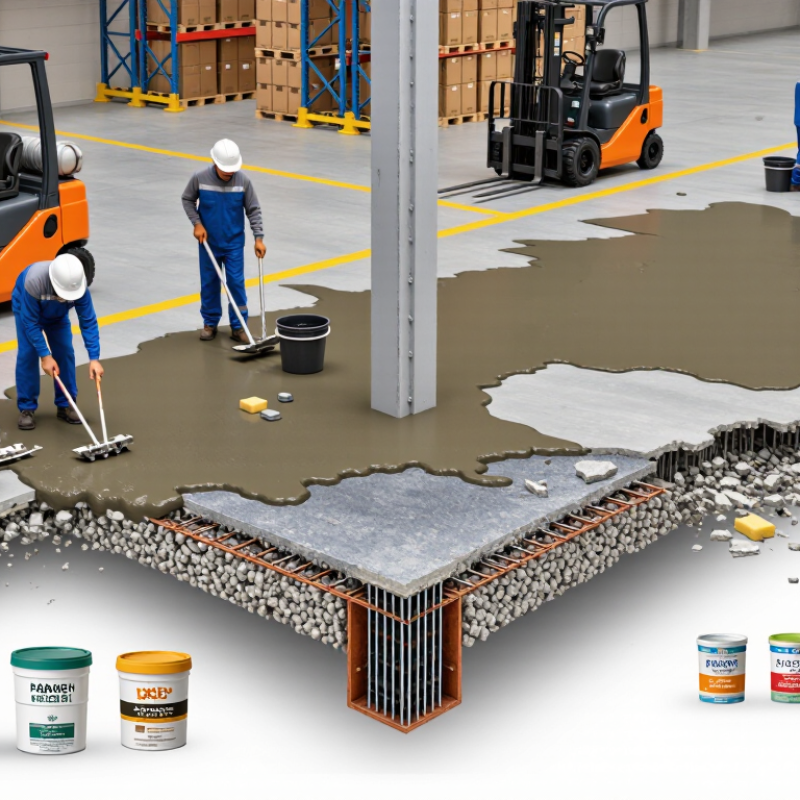
Industrial Floor Repair Mortars: Applications, Materials, and Failure Modes
Industrial floor repair mortars are used to restore damaged aisles, loading bays, production areas, and equipment bases. The right formulation depends on traffic, exposure, repair depth, and the time available before the floor returns to service. A forklift route may need fast reopening, while a washdown zone needs resistance to moisture and cleaning chemicals. Small details matter.
Materials behave differently. Cement-based mortars suit many concrete repairs and can be modified with polymers for improved bond and reduced permeability. Epoxy mortars can offer strong adhesion and chemical resistance, but substrate moisture and temperature can affect application. Check the product’s working time, curing conditions, and compatibility with the existing slab. A familiar material is not automatically the right one. It can fail.
Common failures include debonding, cracking, edge lifting, and surface wear. Dust, oil, weak concrete, or inadequate mechanical preparation can compromise adhesion. Repair edges that are too thin may break under repeated wheel loads. Moisture trapped beneath a low-permeability repair can also cause trouble. Before buying, ask manufacturers for technical data on substrate preparation, minimum thickness, cure time, and service limits. Test a small area when site conditions are uncertain; that extra step can reveal problems, though it does not replace proper inspection.
EN 1504-3 Classes: R4 ≥45 MPa; R3 ≥25 MPa Compressive Strength
For buyers comparing industrial floor repair mortars, compressive strength offers a useful first screen. EN 1504-3:2005 sets minimum strengths of 45 MPa for Class R4 and 25 MPa for Class R3. These values are determined using the test method in EN 12190. Numbers matter. But a higher class does not automatically mean a better repair for every floor.
A loading-bay patch may face forklift wheels, impact, moisture, and repeated cleaning. Check the product’s test report alongside its declared class, substrate requirements, and curing conditions. Strength results are meaningful only when the test method and specimen conditions are clear. Ask suppliers for traceable laboratory documentation, not just a sales sheet. A neat table can still hide important details.
EN 1504-3 also addresses other performance properties, including adhesion and resistance to carbonation, depending on the repair product’s intended use. Review these against the site conditions and the project specification. Preparation matters: weak concrete, dust, or rushed curing can undermine a high-strength mortar. One point buyers can overlook is installation practicality. A material that meets R4 on paper may be a poor fit where crews cannot follow its application window. I would compare compliance, test evidence, and field constraints together.
Top Industrial Floor Repair Mortar Manufacturers for Global Buyers - EN 1504-3 Classes: R4 ≥45 MPa; R3 ≥25 MPa Compressive Strength
| Comparison Dimension | R3 Repair Mortar | R4 Repair Mortar | What Global Buyers Should Verify |
| EN 1504-3 class | Class R3, for structural concrete repair products. | Class R4, for structural concrete repair products. | Check the declared class on the product’s current technical documentation and applicable test reports. |
| Minimum compressive strength | ≥25 MPa | ≥45 MPa | Compare like-for-like test results and confirm the test method, curing conditions, and product version. |
| Typical floor-repair use | Concrete repairs where the specified design and service conditions are compatible with the R3 class. | Concrete repairs where the design calls for the higher minimum compressive-strength class. | Class alone does not determine suitability; assess loads, exposure, substrate condition, and repair design. |
| Product type to compare | Cementitious or polymer-modified repair mortars may be offered; formulations vary by product. | Cementitious or polymer-modified repair mortars may be offered; formulations vary by product. | Confirm binder type, aggregate grading, mixing requirements, and whether the product is intended for the specified application. |
| Application and thickness | Permitted layer thickness and application method are product-specific. | Permitted layer thickness and application method are product-specific. | Request the technical data sheet for minimum and maximum layer thickness, vertical or overhead limitations, and finishing guidance. |
| Substrate preparation | Concrete generally requires sound, clean preparation; exact preparation and moisture requirements depend on the repair system. | Obtain written instructions for removal of unsound concrete, surface profile, pre-wetting or priming, and treatment of reinforcement where relevant. |
| Performance documentation | EN 1504-3 classification and declared performance should be supported by product documentation. | Request a current Declaration of Performance where applicable, technical data sheet, safety data sheet, and test documentation for the exact product supplied. |
| Project and export checks | Packaging, shelf life, storage limits, and market documentation vary by supplier and destination. | Confirm local regulatory requirements, language of documentation, batch traceability, transport conditions, lead time, and availability of technical support. |
| Note: EN 1504-3 class thresholds shown here are minimum compressive-strength values. Select a repair mortar based on the full project specification and verified product documentation, not compressive strength alone. |
How Leading Manufacturers Compare on Cure Time, Bond, and Chemical Resistance
Cure time is often the first figure buyers compare, but the number needs context. A mortar that accepts foot traffic in four hours may need longer before forklift use or chemical exposure. Ask manufacturers to state the test temperature, application thickness, and traffic class behind each figure. Site conditions matter. A cold slab can slow curing, while a warm, drafty room may shorten working time. Fast is not always easier.
Bond performance depends on both the mortar and the concrete beneath it. Compare reported pull-off strength, test method, and failure location—not just a headline value. If failure occurs in the concrete, the interface may be stronger than the slab itself. Ask what surface preparation is required, such as shot blasting or grinding, and whether primers are necessary. Small details can shift labor costs. And yes, product data rarely captures every uneven, damp corner of a real floor.
Chemical resistance should be judged against the actual spill, its concentration, temperature, and contact duration. Request test results for the specific acids, oils, cleaners, or solvents used at the facility. A broad “chemical resistant” claim is not enough. Some systems tolerate brief splashes but soften under prolonged pooling. That distinction is easy to miss. Where practical, verify performance with a small trial area and written application guidance.
Global Buyer Checks: Standards, Climate Suitability, Packaging, and Lead Times
For global buyers, a product sheet is only the starting point. Check which test standards support the stated compressive strength, bond strength, abrasion resistance, and curing time. Ask for current test reports, not just performance figures copied into a brochure. Confirm that the specified method matches the project documents and local requirements; similar test names do not always mean identical procedures. Small detail, big difference. Also check whether the mortar is intended for the actual repair depth and traffic level. A forklift aisle and a shallow patch beside a loading bay face different stresses.
Climate can change how a repair mortar behaves. Ask for application temperature limits and guidance on hot, dry, or humid conditions. A sun-warmed slab may shorten working time, while a cold, damp floor can delay curing. Packaging matters too: moisture-resistant, sealed bags help protect powder during storage and transit. Check bag weight, pallet configuration, batch identification, and remaining shelf life on arrival. Lead times should include sample approval, production, export handling, and inland delivery, with extra allowance for seasonal congestion. I have seen schedules look sound on paper, then slip because one approval took longer than expected. Build in a buffer, and confirm it in writing.
Compare Total Installed Cost, Downtime, and Expected Service Life
When comparing industrial floor repair mortars, purchase price is only one part of the cost. A fast-setting material may reduce closure time, but only if the crew can prepare and place it within the specified working window. Check whether the estimate includes grinding, crack treatment, edge removal, and cleanup. These steps matter. Skipping preparation can lead to early failure, even when the mortar itself is suitable.
Calculate total installed cost per repaired area, including labor, equipment, surface preparation, traffic control, and any return visit. Then compare the time before forklifts or other traffic can safely return. A repair that cures in hours may be valuable in a busy loading bay. Yet a rushed installation can create uneven edges or weak bonding. Ask suppliers for written cure conditions, including temperature and moisture limits. Small details add up.
Expected service life depends on traffic, impact, chemicals, moisture, and maintenance—not just the product description. Request project references with similar loads and operating conditions, plus clear limits on any service-life estimate. It is tempting to rank materials by a single number, but real floors are less tidy than a spreadsheet. Build a comparison using the same repair area and downtime assumptions for every option. Then review which costs are measured and which are merely estimated.