
What Are Industrial Aluminum Profiles Used For?
Industrial Aluminum Profiles are not merely metal rails. They are engineered cross-sections that support loads, guide motion, and carry services through machines and buildings. Walk through a factory, and you may find them framing a conveyor, guarding a robotic cell, or holding sensors beside a production line. Their appeal is practical: profiles can be cut, joined, and reconfigured without building every frame from scratch.
The International Aluminium Institute’s 2024 report, Aluminium: The Path to Net Zero, projects global aluminium demand could grow by nearly 40% by 2030 compared with 2020. That forecast describes the wider metal market, not profiles alone, but it signals rising pressure to use aluminium efficiently. The International Energy Agency also identifies aluminium production as an energy-intensive industrial process. Lightweight designs help, but they do not erase the energy used to make primary metal. Recycled content, suitable alloys, and thoughtful sizing matter.
Metallurgist Joost R. Hirsch is a recognized aluminium-industry expert. A practical paraphrase of his materials-focused work is: “Match the alloy and extrusion process to the application.” This is a design principle, not a verbatim quotation. In use, that means checking loads, corrosion exposure, connection details, and tolerances before choosing a profile. A slim section may look elegant. It may also flex under repeated vibration. A costly mismatch. The sections ahead examine where Industrial Aluminum Profiles perform well, what limits them, and how engineers select them with evidence rather than guesswork.
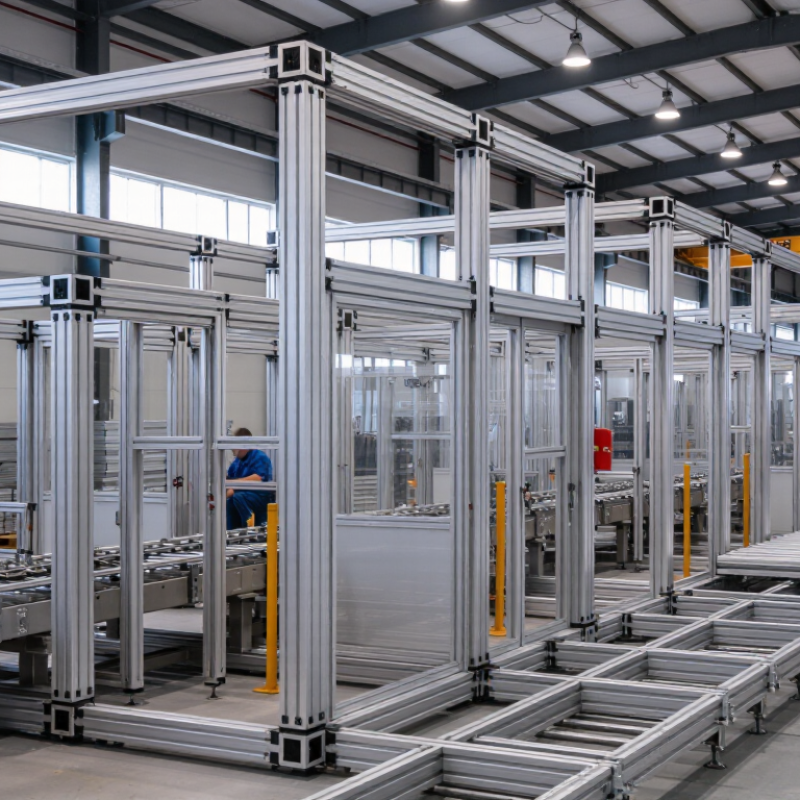
Table of Contents [Hide]
What Industrial Aluminum Profiles Are and How They Are Made
Industrial aluminum profiles are continuous shapes with a consistent cross-section, such as T-slots, channels, and hollow tubes. They commonly form machine frames, conveyor rails, workstations, and protective enclosures. Most are made by extrusion: an aluminum-alloy billet is heated, then pushed through a steel die that shapes the metal. The emerging profile is cooled, stretched straight, cut to length, and often heat-treated to reach its required strength. Details matter. A small die change can affect wall thickness, fit, and how easily parts assemble.
The process is precise, but not flawless. Thin sections may twist or bow during cooling, so manufacturers check dimensions and adjust tooling or process settings. Alloy choice also affects strength, corrosion resistance, and finishing options. The International Aluminium Institute reports that recycling aluminum can save up to 95% of the energy needed to produce primary aluminum. That makes recycled feedstock valuable, although its suitability depends on alloy quality and the intended application.
Tips: Specify loads, slot dimensions, and tolerances before ordering. Check that mating parts fit after finishing, not just in the drawing.
| Topic | Details | Typical Examples | Why Aluminum Is Used |
|---|---|---|---|
| What an industrial aluminum profile is | A length of aluminum alloy shaped by extrusion into a consistent cross-section. Profiles may be solid, hollow, or designed with slots and channels for fastening. | T-slotted framing, square tubes, channels, angles, and custom structural sections | The cross-section can combine strength, low weight, and useful mounting features. |
| Machine and equipment frames | Profiles are assembled into modular frames, guards, workstations, and support structures. | Automation cells, inspection stations, machine enclosures, and assembly benches | Modular connections can simplify assembly, adjustment, and later reconfiguration. |
| Conveyors and material handling | Extrusions provide structural rails and frames for moving, guiding, or supporting products and components. | Conveyor frames, guide rails, transfer tables, and handling equipment supports | A favorable strength-to-weight ratio helps limit structural mass while providing practical rigidity. |
| Workstations and safety guarding | Profiles form configurable supports for benches, panels, doors, and protective barriers. | Production workstations, machine guards, tool racks, and protective enclosures | Cut-to-length members and mechanical connectors can make modifications straightforward. |
| Heat sinks and thermal components | Profiles with fins or other extended surfaces are used to transfer heat away from components. | Electronic equipment cooling, LED fixtures, and power-device heat sinks | Aluminum conducts heat effectively and can be extruded into complex fin geometries. |
| Common alloys and tempers | Alloy and temper are selected according to requirements such as strength, formability, corrosion resistance, and surface finish. | 6063 is commonly used for many architectural and general-purpose extrusions; 6061 is often chosen where higher strength is needed. | Different alloy compositions and heat treatments provide different property combinations. |
| 1. Billet preparation | An aluminum alloy billet is cut to length and heated to a controlled temperature suitable for extrusion. | Billet size and alloy are matched to the press, die, and required profile. | Controlled heating helps the metal flow through the die during forming. |
| 2. Die design and extrusion | A hydraulic press pushes the heated billet through a shaped steel die to create a continuous profile with the die's cross-section. | The die opening determines features such as walls, hollows, slots, and fins. | One extrusion process can produce a long, consistent section that can later be cut to length. |
| 3. Cooling and straightening | The emerging profile is cooled, stretched or straightened as needed, and cut into manageable lengths. | Cooling methods and handling depend on alloy, section shape, and production requirements. | These steps help control shape and prepare the extrusion for subsequent processing. |
| 4. Heat treatment and finishing | Depending on the required temper, profiles may be heat-treated, then finished with processes such as anodizing, painting, or powder coating. | Finishing may improve appearance or provide a surface suited to the intended environment. | Heat treatment can develop specified mechanical properties; surface treatments can alter surface protection and appearance. |
| 5. Fabrication and inspection | Finished profiles may be cut, drilled, milled, or assembled, followed by checks against relevant dimensional and quality requirements. | Fabricated lengths, machined parts, and assembled modular structures | Secondary operations adapt standard or custom extrusions to their final application. |