China Best Gramophone Record Player Manufacturers
Finding China’s best Gramophone Record Player manufacturers takes more than comparing attractive catalogs or low quoted prices. Buyers need to understand how each supplier balances sound quality, construction, customization, and production consistency. A useful assessment starts with practical details: platter stability, motor noise, tonearm adjustment, cartridge compatibility, and the feel of switches and controls. Cabinet finish matters too, especially when a player will be displayed in a living room or retail showroom. These details are easier to judge through a working sample than through product photos alone. Ask for clear specifications, quality-control procedures, and packaging details before making a decision.
This guide explains how to compare Chinese manufacturers by product range, customization options, minimum order quantities, lead times, and after-sales support. It also highlights questions to ask about sample testing and documentation, since requirements can vary by destination market and product configuration. No supplier is flawless. A low unit price may come with longer lead times, while extensive customization can make production more complex. That trade-off matters. Buyers should verify claims directly, request written quotations, and test samples under realistic listening conditions. The right partner is not simply the factory with the boldest promises; it is one whose capabilities, communication, and quality checks fit the buyer’s needs. Even careful research leaves some uncertainty, so build time for follow-up questions and independent sample review.
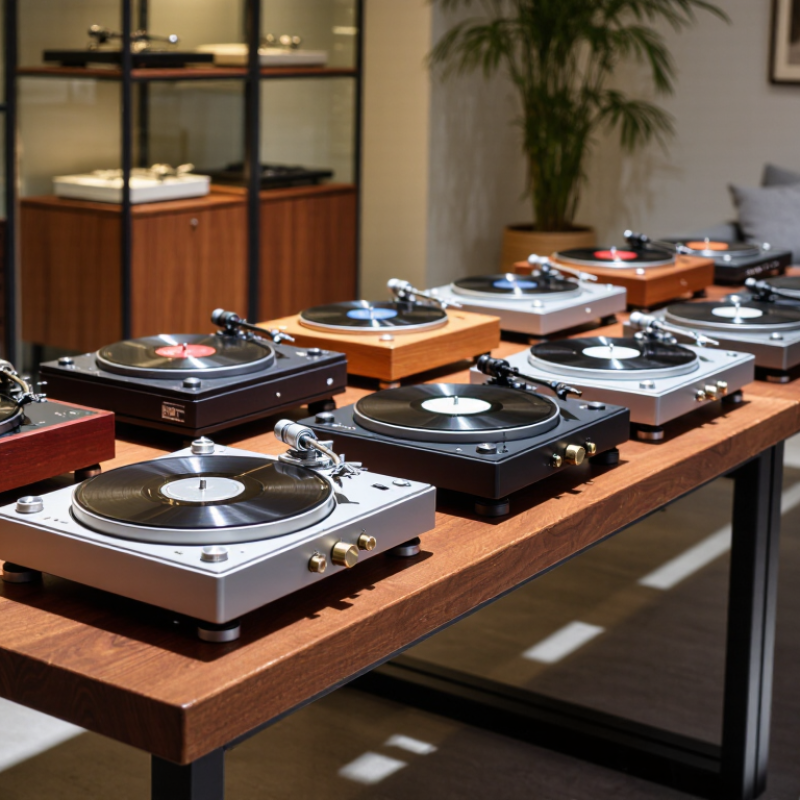
Overview of China’s Gramophone Record Player Industry
China Best Gramophone Record Player Manufacturers
Overview of China’s Gramophone Record Player Industry
China’s gramophone record player industry draws on a broad electronics supply chain, including motors, tonearms, molded cabinets, and audio components. Yet public statistics rarely separate record players from wider consumer electronics. That makes precise production estimates difficult. The gap matters.
Demand is tied partly to renewed interest in vinyl. IFPI’s Global Music Report 2024 recorded a 6% rise in global vinyl revenue in 2023, marking the format’s seventeenth consecutive year of growth. This is a useful demand signal, not a measure of Chinese factory output. The distinction is easy to miss.
China’s manufacturing base provides relevant context. MIIT reported that the added value of the country’s electronic information manufacturing sector grew 3.4% in 2023. That sector is much broader than record players, so the figure should not be treated as product-specific evidence. For buyers, practical evaluation still comes down to details: stable platter speed, low motor noise, clean wiring, and consistent assembly. A quiet room reveals flaws quickly. Product-level data remains thin, and that limits confident comparisons between manufacturers.
(Sources: IFPI, Global Music Report 2024; China MIIT, 2023 electronic information manufacturing industry statistics.)
How Gramophone Record Players Are Designed and Manufactured
Designing a gramophone record player begins with a simple question: how should each part control vibration? Engineers select a stable plinth, quiet motor, platter, tonearm, and cartridge as a coordinated system. Even a small change in platter mass can affect startup time and speed stability. The tonearm must move freely yet resist unwanted resonance. That balance is delicate. Prototype teams measure rotational speed, bearing noise, tracking force, and playback consistency across repeated tests. They also listen.
Manufacturing turns these design choices into repeatable tolerances. Workers machine or mold the plinth, inspect spindle alignment, and check that the platter sits level. Motor mounts and feet are examined because vibration can travel through a desk and reach the stylus. Assembly typically includes wiring, cartridge alignment, tonearm adjustment, and a final playback test using a reference record. Measurements matter, but they do not reveal every problem. A unit may pass a speed check and still produce hum or uneven tracking in a quiet room. Patient troubleshooting helps. Material variation and rushed adjustments can leave small inconsistencies, so careful manufacturers document test results and refine their fixtures and inspection routines.
Profiles of Leading Chinese Gramophone Player Manufacturers
China’s gramophone player manufacturers vary in scale and technical focus. Some concentrate on vintage-inspired cabinets, using wood finishes, visible turntables, and tactile control knobs. Others emphasize compact designs and practical features, such as adjustable speed settings and built-in speakers. These profiles describe broad manufacturing approaches, not a ranking; capabilities can differ between production runs.
A closer assessment looks beyond appearance. Ask how each manufacturer checks motor stability, tonearm movement, and cartridge alignment. Request clear product specifications, sample inspection details, and information about replacement parts. Experienced suppliers should explain setup and maintenance in concrete terms. A glossy finish is not proof of careful engineering. I would also verify claims independently; catalogs can leave important details out.
Tips: Compare the same record across listening tests, if possible. Check for steady rotation and unwanted vibration. Ask who handles quality checks, and get answers in writing. Small details matter.
How to Evaluate Manufacturers, Products, and Quality
Choosing a gramophone record player manufacturer requires more than attractive photographs or a polished catalogue. Ask how each unit is inspected before shipment, and request measurable specifications for speed accuracy, tracking force, and channel balance. A stable platter should rotate evenly, without visible wobble. Small details matter. Check whether the tonearm can be adjusted and whether replacement styli and belts are available.
Evaluate a physical sample under ordinary listening conditions. Play a familiar record at both 33⅓ and 45 RPM, then listen for hum, uneven speed, and distortion. Inspect the tonearm bearings, hinges, wiring, and finish closely. Ask for test records, inspection procedures, and clear product documentation. Claims are useful, but repeatable measurements are stronger evidence. If possible, compare several units from the same production batch.
Quality also depends on consistent production, not just one impressive sample. Ask how incoming components are checked and how defects are recorded. Confirm warranty terms, repair support, packaging protection, and access to service parts. A manufacturer that answers technical questions clearly is easier to assess. Still, a short demonstration cannot reveal every long-term issue. That is an easy point to overlook. Keep notes, request written specifications, and treat vague answers as a reason to investigate further.
Export Markets and Industry Trends in China’s Record Player Sector
China’s record-player sector serves overseas buyers through contract manufacturing, custom assembly, and finished-unit shipments. Export destinations vary by supplier and product tier; Europe and North America are common target regions. Online sales also give smaller markets access to more products. Demand is uneven. Some customers want a simple belt-drive player, while others request wood-effect cabinets, replaceable cartridges, or built-in speakers. These choices affect component sourcing and final inspection.
Export readiness involves more than producing a turntable that spins. Factories need to check destination-specific power requirements, plug formats, labels, manuals, packaging strength, and applicable product tests. A tonearm that tracks poorly can cause returns, even when the cabinet looks polished. Suppliers may test speed stability, arm movement, channel balance, and vibration before packing. Transit protection matters too. A loose platter or cracked dust cover can turn a sound product into a costly complaint.
Current trends include compact designs, wireless audio, and easier setup, alongside renewed interest in traditional controls. Not every feature improves the listening experience; wireless functions can add cost and service complexity. Exporters also face changing freight rates, retailer margin pressure, and seasonal orders. Buyers increasingly ask for quality records and spare-part plans. Smaller shipments can make that support expensive. That gap is still real.