Top 10 Best Car Aroma Diffusers for Wholesale Buyers
A wholesale order can look simple on a screen. The details matter once units reach a shop floor or a customer’s car. This guide to the Top 10 Best Car Aroma Diffusers for Wholesale Buyers compares practical features, not just polished product photos. It considers power options, refill methods, materials, noise, controls, and ease of cleaning. A Car Aroma Diffuser should fit common vehicle layouts without blocking cup holders or distracting drivers. Small details count: a secure vent clip, a clearly marked button, and packaging that protects the device in transit.
The products highlighted here serve different needs, from compact vent-mounted models to rechargeable diffusers with adjustable settings. Wholesale buyers can use the comparison to assess product range, likely customer fit, and the questions worth asking suppliers. Requesting samples is sensible; specifications alone cannot show how a device feels, smells, or performs after repeated use. That is a limitation worth admitting. Fragrance preferences vary, and even a well-made diffuser may not suit every buyer. Check refill availability, warranty terms, and order quantities before making a larger commitment. A low unit price can be tempting. It is not the whole story. The right choice balances dependable construction, straightforward operation, consistent supply, and a realistic price point.
Car Aroma Diffusers: Product Scope and the 10-Type Comparison
Car Aroma Diffusers: Product Scope and the 10-Type Comparison
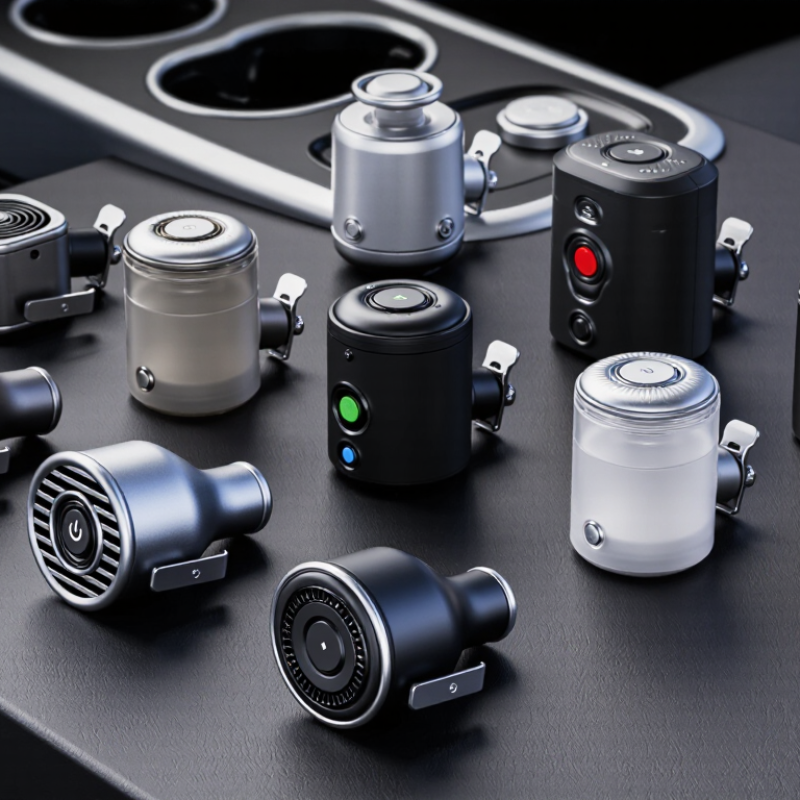
Car aroma diffusers span passive and powered formats. A useful wholesale comparison covers ten types: vent clips, hanging liquid bottles, wooden-cap bottles, paper scent cards, gel cups, solid fragrance tins, USB fan diffusers, water-based ultrasonic units, nebulizing units, and rechargeable portable diffusers. Some categories overlap; a wooden-cap bottle, for example, is still a liquid diffuser. Small details matter. Compare refill access, materials, fragrance output, and vehicle fit—not appearance alone.
Passive products need no charging, but scent output can vary with cabin temperature and airflow. Liquid formats may need leak-resistant closures and upright storage. Powered units offer more control, yet add charging, noise, cleaning, or component checks. For wholesale buying, request capacity, runtime, refill compatibility, packaging dimensions, and sample-testing details. Test products in different vent positions and cabin conditions. One sample is not enough.
Tips: Check cartridge availability and replacement instructions before placing a bulk order. Ask for samples from more than one production batch. Fragrance preference is subjective, and a tidy product listing cannot predict every driver’s experience.
Top 10 Car Aroma Diffuser Types: Product Scope Comparison
A product-type overview for wholesale buyers, comparing whether each common diffuser format uses powered operation.
Reading the chart: 0 = passive fragrance release; 1 = powered operation. The values classify the operating principle of each listed product type—not sales, market share, or performance. Specific designs can vary by manufacturer.
Wholesale Metrics: MOQ, Unit Cost, Capacity, and Reorder Lead Time
Top 10 Best Car Aroma Diffusers for Wholesale Buyers
Wholesale Metrics: MOQ, Unit Cost, Capacity, and Reorder Lead Time
For wholesale buyers, MOQ is a cash-flow threshold, not just a supplier checkbox. Ask whether it applies per model, color, or cartridge; mixed cartons can change the true entry cost. Small orders cost more. Request quotes at three quantities, such as 500, 1,000, and 3,000 units, and compare packaging inclusions. Compare unit cost on the same basis: diffuser, cable, retail box, and any included refill. That gap matters.
Capacity deserves a closer look than a single milliliter figure. A compact reservoir may suit short commutes, while larger capacity can add weight and affect cup-holder fit. Ask for tested runtime at the stated output setting; capacity alone cannot predict how long fragrance lasts. Check whether the sample’s reservoir, cap, and finish match the production specification.
Separate reorder lead time into component sourcing, assembly, inspection, and shipping. A 20-day production estimate, for example, may exclude transit and pre-shipment checks. Confirm the clock starts after artwork approval and deposit, then add a buffer for seasonal demand. Keep reorder terms in writing, including carton quantity and rules for combining colors. Forecasts are often wrong, so avoid tying every unit of cash to a single model.
Top 10 Best Car Aroma Diffusers for Wholesale Buyers - Wholesale Metrics: MOQ, Unit Cost, Capacity, and Reorder Lead Time
Indicative wholesale planning benchmarks in USD. Unit costs are estimated ex-works prices for standard, unbranded products; actual pricing, minimum order quantities, and lead times vary by supplier, materials, customization, and order volume.
Safety and Compliance: IFRA Category 12, SDS, and Transport Documents
For car aroma diffusers, ask suppliers for an IFRA certificate covering Category 12 and the specific fragrance formula. Check that the stated use level suits the fragrance concentration in the finished product. A certificate is useful evidence, but it does not prove that every part of the diffuser is safe or compliant. Details matter.
Request a current Safety Data Sheet (SDS) for the actual mixture, not a generic sample. Review its hazard identification, handling guidance, physical properties, and transport information. For a liquid diffuser, confirm that the SDS describes the same formula and packaging you plan to order. Small mismatches happen. They deserve follow-up.
Transport documents should reflect the product’s classification, quantity, packaging, and shipping method. Do not assume every fragrance liquid is regulated the same way; ask a qualified logistics provider to verify the shipment requirements. Keep the SDS, IFRA documents, product specifications, and batch records together. Before approving a bulk order, compare the paperwork with a sample label and the product in hand. Documents can look complete while leaving a practical question unanswered: does this exact formulation match the one being shipped?
Ranking the Top 10: Score Fit, Scent Control, Durability, and Value
For wholesale buyers, rank each car aroma diffuser on fit, scent control, durability, and value—not fragrance alone. Fit means a secure vent clip or stable dashboard base, with no blocked controls. Score scent control by checking whether settings offer a genuinely mild option. Strong scent is not always better. Durability should cover refill sealing, heat exposure, and vibration during ordinary driving. Value includes refill cost and replacement availability, not just the unit price.
Grand View Research’s Air Freshener Market report valued the global market at USD 12.03 billion in 2023 and projected 5.3% annual growth from 2024 to 2030. This broad category includes more than automotive products, so it signals market context, not car-diffuser demand specifically. For a top-ten comparison, buyers can assign equal scores to the four criteria, then check sample units across different vent shapes and cabin temperatures. A low-cost model may score well initially yet disappoint if refills are hard to source. That trade-off deserves a lower value rating.
Tips: Test a sample in a compact car and an SUV. Record scent strength after one hour and one week. Note any leakage, loose fittings, or fading controls; small defects can become costly at wholesale scale.